

Lesson: Prompt Engineering
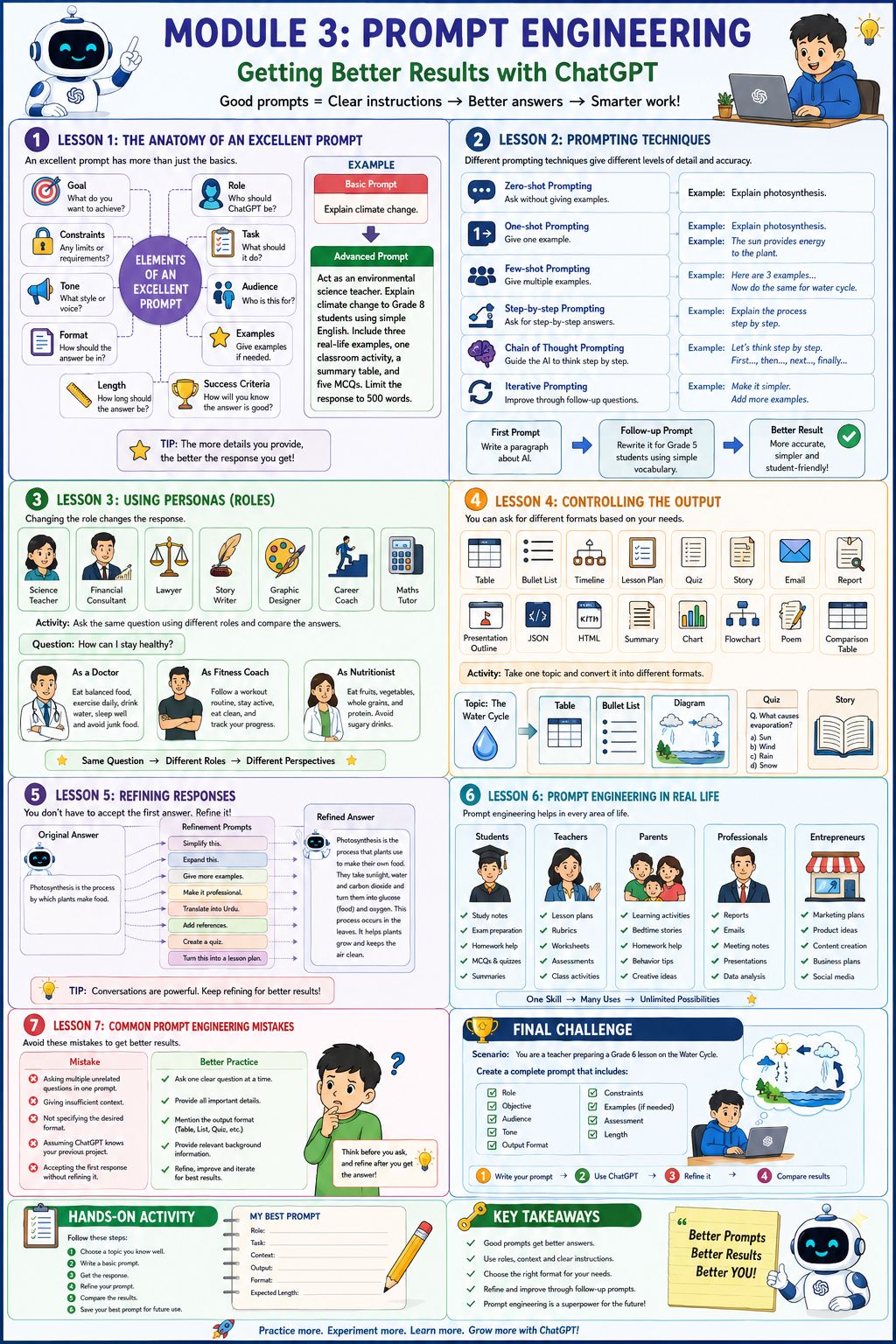
Introduction
Prompt engineering is the skill of writing clear, detailed, and well-structured instructions that help ChatGPT produce accurate, relevant, and useful responses. A prompt is simply the information or question you give to an AI model. The quality of the response depends greatly on the quality of the prompt.
Think of ChatGPT as a highly knowledgeable assistant. Like any assistant, it performs best when it receives clear instructions. If your request is vague or incomplete, the response may also be general or miss important details. However, when you provide specific instructions, background information, and clear expectations, ChatGPT can generate responses that are more accurate, organized, and tailored to your needs.
Prompt engineering is not a programming language or a technical skill reserved for computer scientists. It is a practical communication skill that anyone can learn. Teachers use prompt engineering to prepare lesson plans and assessments, students use it to understand difficult concepts and revise for examinations, professionals use it to organize information and solve problems, and content creators use it to generate ideas and improve their writing.
As artificial intelligence becomes a common tool in education and the workplace, knowing how to communicate effectively with AI is becoming an essential digital literacy skill. Learning prompt engineering enables users to obtain higher-quality responses while saving time and improving productivity.
What Is Prompt Engineering?
Prompt engineering is the process of designing, refining, and improving prompts so that an AI system understands exactly what you want and produces the most helpful response possible.
Rather than asking a simple question, prompt engineering involves giving the AI enough information to understand:
- Your goal
- The task you want completed
- The audience
- The context
- The preferred output format
The more clearly you describe your requirements, the better the AI can respond.
Why Is Prompt Engineering Important?
Prompt engineering improves both the quality and usefulness of AI-generated responses.
When prompts are carefully written, they help you:
- Receive more accurate answers.
- Save time by reducing follow-up questions.
- Generate responses suited to your audience.
- Produce organized and professional content.
- Encourage creative and critical thinking.
- Improve learning and problem-solving.
- Make better use of AI tools in education and daily life.
Instead of repeatedly correcting AI responses, a well-written prompt often produces the desired result the first time.
How Prompt Engineering Works
Prompt engineering follows a simple communication process.
Step 1: Think about your goal.
Decide exactly what you want ChatGPT to do.
Step 2: Write a clear prompt.
Provide specific instructions rather than a vague request.
Step 3: Include useful context.
Mention the subject, grade level, audience, purpose, or background information.
Step 4: Specify the desired output.
Tell ChatGPT how you would like the response presented, such as a table, lesson plan, quiz, summary, story, or bullet points.
Step 5: Review and refine.
If necessary, improve your prompt by adding more detail or changing the instructions.
Real-Life Example
Imagine two teachers preparing tomorrow’s science lesson.
Teacher A writes:
Explain photosynthesis.
ChatGPT provides a short explanation.
Teacher B writes:
Act as an experienced Grade 5 science teacher. Explain photosynthesis using simple language, real-life examples, colorful diagram descriptions, classroom activities, five multiple-choice questions, one worksheet, and a homework assignment.
ChatGPT now produces a complete teaching resource ready for classroom use.
The difference is not the AI—it is the quality of the prompt.
Characteristics of an Effective Prompt
Good prompts usually have the following qualities:
- Clear and specific
- Easy to understand
- Includes sufficient background information
- States the intended audience
- Explains the desired outcome
- Requests the preferred response format
- Avoids unnecessary ambiguity
Characteristics of a Poor Prompt
Poor prompts often:
- Are too short or vague
- Lack context
- Do not specify the audience
- Give unclear instructions
- Ask multiple unrelated questions at once
- Do not explain the expected output
These prompts often produce responses that require additional editing or clarification.
⭐ Interactive Activity: AI Prompt Playground
Practice What You Have Learned
Now that you understand the principles of prompt engineering, it’s time to see how prompt quality affects AI responses.
The AI Prompt Playground allows you to compare Poor, Better, and Perfect prompts used by teachers and students.
Instructions
- Select Teacher or Student.
- Choose one of the prepared examples.
- Compare the Poor, Better, and Perfect prompts.
- Observe how adding context, audience, and clear instructions improves the quality of the prompt.
- Copy the Perfect Prompt and try it in ChatGPT to experience the difference yourself.
Learning Tip: Good prompt engineering is not about asking longer questions—it is about asking clearer, more specific, and well-structured questions.
Benefits of Learning Prompt Engineering
By mastering prompt engineering, you will be able to:
- Communicate more effectively with AI.
- Produce higher-quality educational content.
- Save time on repetitive tasks.
- Improve research and study habits.
- Generate creative ideas quickly.
- Personalize learning experiences.
- Build confidence when using AI tools.
Prompt engineering is becoming one of the most valuable digital skills for students, teachers, and lifelong learners.
Key Takeaway
Prompt engineering is the art of asking better questions and giving clearer instructions to AI. The quality of ChatGPT’s response depends largely on the quality of your prompt. By learning how to provide a role, define a task, add context, and specify the desired output, you can transform simple questions into powerful AI conversations that support learning, creativity, teaching, and productivity.