
What Is Artificial Intelligence?
Artificial Intelligence (AI) is a branch of computer science that enables machines to perform tasks that normally require human intelligence. These tasks include understanding language, recognizing images, solving problems, making decisions, learning from data, and generating new content. AI systems are designed to analyze information, identify patterns, and provide useful responses based on the data they have been trained on. Today, AI is transforming many sectors, including healthcare, finance, transportation, manufacturing, and education. In education, AI is becoming an important tool that supports both teaching and learning. Teachers can use AI to prepare lesson plans, create quizzes, design worksheets, and generate engaging classroom activities in a fraction of the time it would normally take. Students can use AI to understand difficult concepts, practice problem-solving, improve writing skills, learn new languages, and receive personalized explanations that match their learning needs. However, AI should be viewed as an assistant rather than a replacement for teachers. Human creativity, critical thinking, and personal interaction remain essential parts of quality education.

What Is Generative AI?
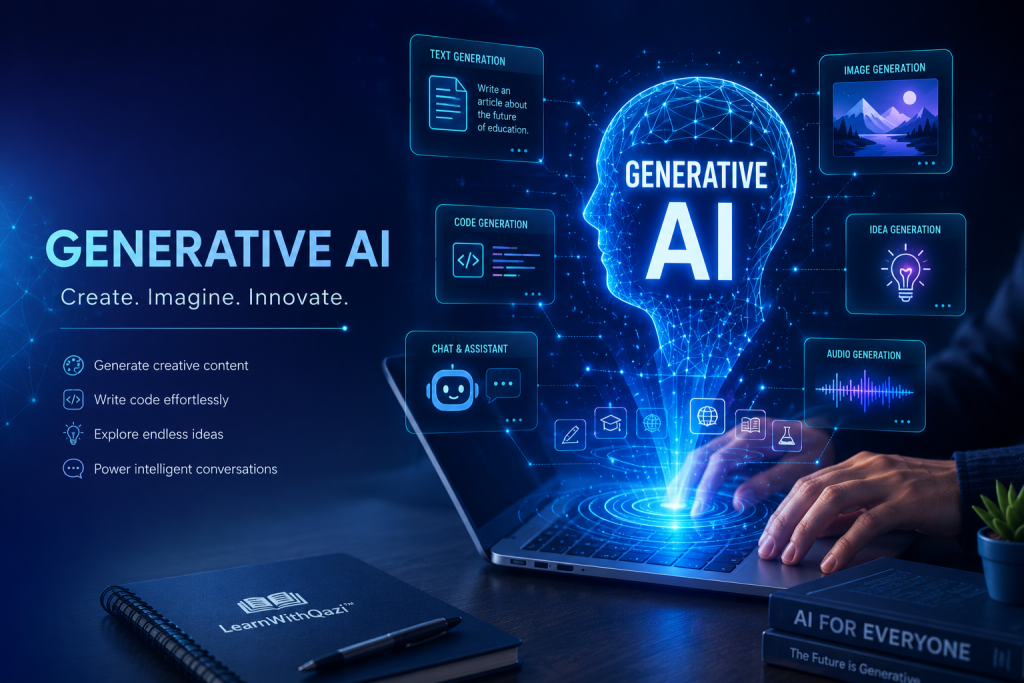
Generative AI is a type of Artificial Intelligence that can create new content based on user instructions, commonly called prompts. Instead of simply searching for existing information, Generative AI produces original text, images, presentations, computer code, audio, videos, and other forms of content. It learns patterns from large amounts of data and uses that knowledge to generate responses that are relevant to the user’s request. Popular Generative AI tools include ChatGPT, Google Gemini, Claude, Microsoft Copilot, and Grok. Each tool has unique strengths, but they all share the ability to assist users in completing tasks more efficiently. In education, Generative AI can help teachers prepare instructional materials, create differentiated learning activities, and design assessments. Students can use it for brainstorming ideas, summarizing information, practicing writing, solving mathematical problems, and exploring scientific concepts. Although Generative AI is powerful, users should always verify important information because AI-generated responses may occasionally contain errors or outdated content
What Is ChatGPT?
ChatGPT is an AI-powered conversational assistant developed by OpenAI. It uses advanced language models to understand questions written in natural language and generate clear, detailed, and context-aware responses. Unlike traditional search engines that provide a list of web pages, ChatGPT interacts with users through conversation, making it feel like communicating with a knowledgeable tutor or assistant. ChatGPT can answer questions, explain concepts, write articles, summarize documents, solve mathematical problems, generate programming code, translate languages, create lesson plans, prepare quizzes, and assist with many other educational and professional tasks. Because it understands context, users can continue asking follow-up questions without repeating the entire conversation. This makes ChatGPT especially valuable for learning, research, and classroom support.
The Evolution of ChatGPT
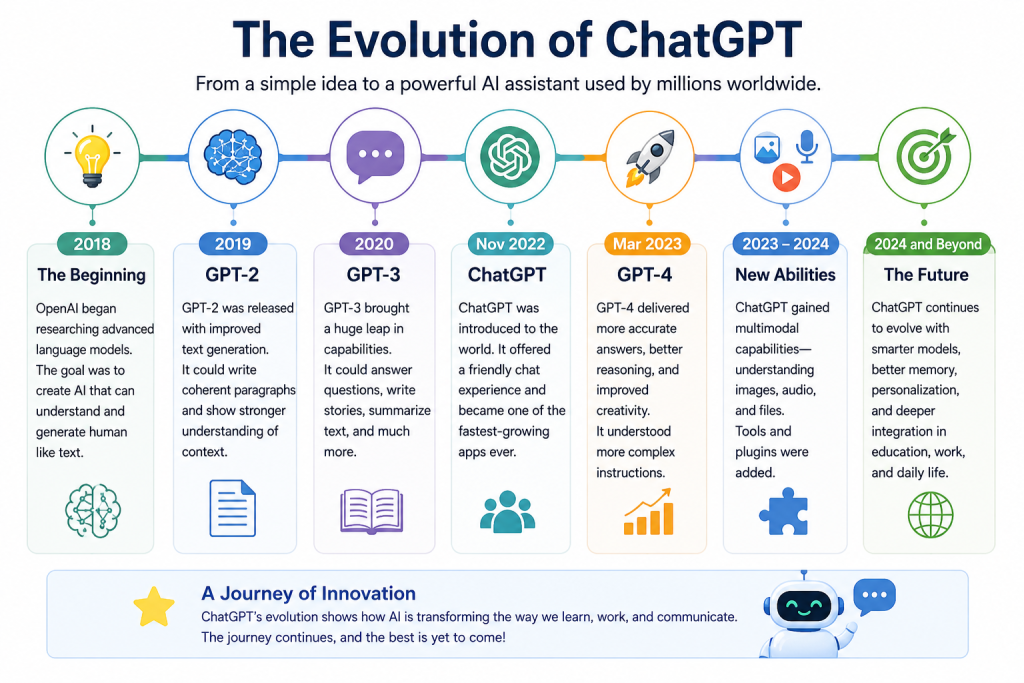
ChatGPT was introduced by OpenAI in late 2022 and quickly became one of the fastest-growing AI applications in history. Since its release, it has evolved through multiple generations of language models, each offering improvements in reasoning, accuracy, creativity, and multimodal capabilities. Modern versions of ChatGPT can understand text, images, and, in some cases, audio, making them more versatile than earlier versions. As AI technology continues to develop, ChatGPT is becoming an increasingly useful educational companion. Schools, universities, researchers, businesses, and professionals around the world are exploring ways to integrate AI into daily learning and work while maintaining ethical and responsible practices.
How Does ChatGPT Work?
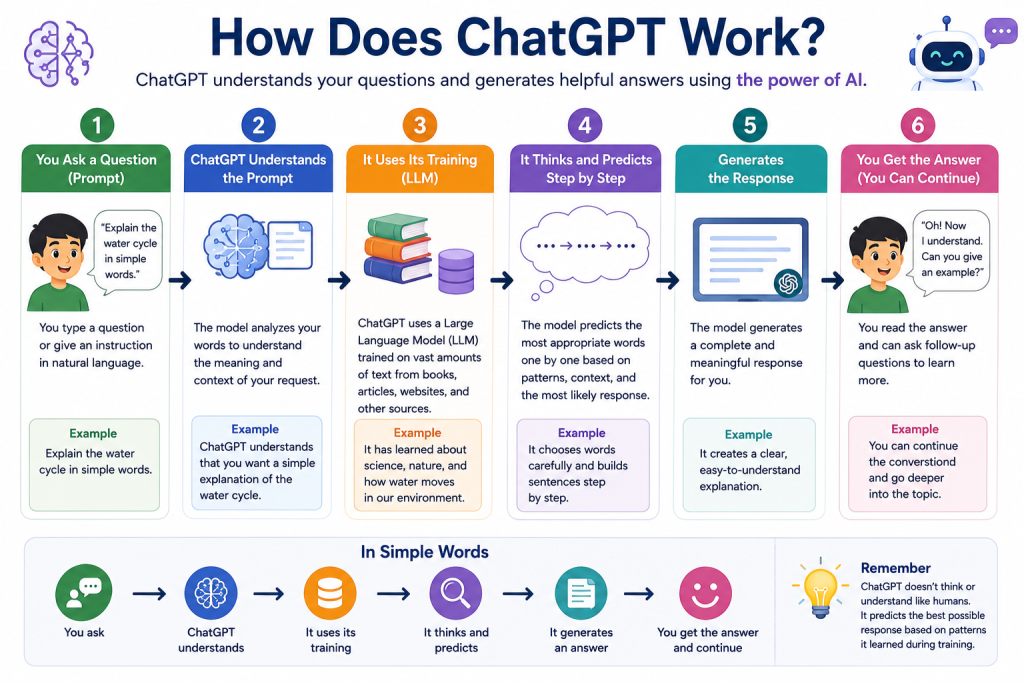
ChatGPT is based on a Large Language Model (LLM), a type of Artificial Intelligence trained on vast collections of text from books, articles, websites, and other publicly available sources, along with licensed and human-created training data. During training, the model learns patterns, grammar, vocabulary, and relationships between words and ideas. When a user submits a prompt, ChatGPT predicts the most appropriate response by analyzing the context and generating text one word at a time. Although ChatGPT can produce highly accurate and helpful answers, it does not think or understand information in the same way humans do. Instead, it identifies patterns in language and predicts likely responses based on its training. For this reason, users should always review AI-generated content, especially when dealing with academic work, professional reports, legal matters, medical information, or other important decisions.
Free and Paid Versions of ChatGPT
ChatGPT is available in both free and paid plans. The free version allows users to experience many of the platform’s core capabilities, including asking questions, generating text, brainstorming ideas, and receiving explanations. The paid subscription provides access to additional features, which may include access to more advanced AI models, faster response times, higher usage limits, and enhanced tools depending on the current subscription offering. For most students and teachers, the free version is sufficient for everyday educational tasks such as learning concepts, drafting content, solving problems, and preparing classroom materials. Users with advanced professional or organizational needs may benefit from the additional features offered in paid plans.
Educational Benefits of ChatGPT
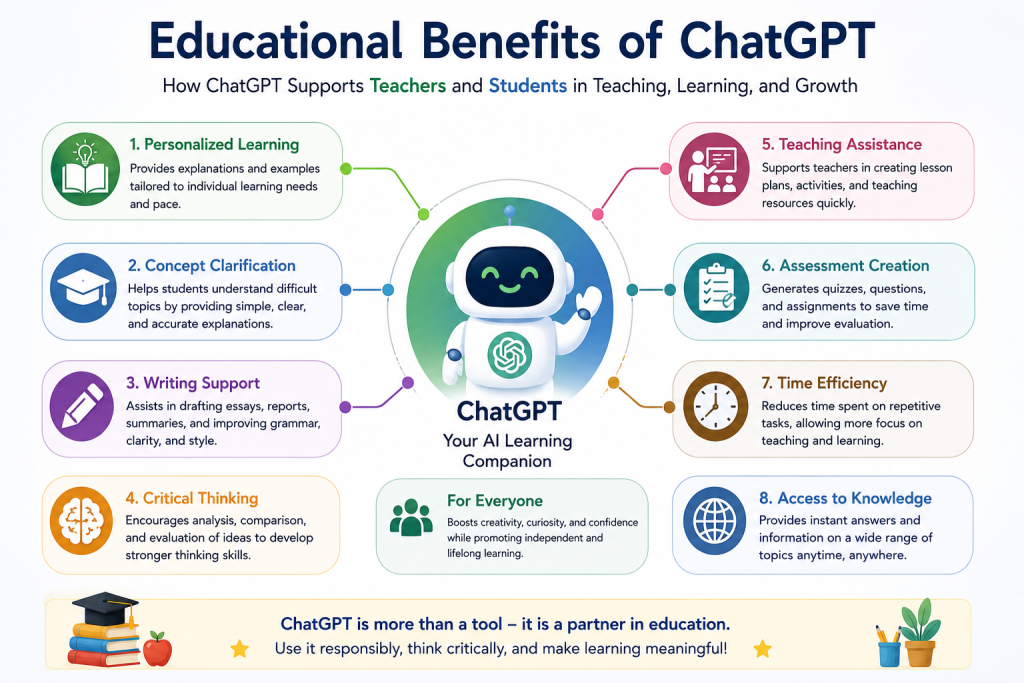
ChatGPT has the potential to transform teaching and learning by making education more personalized, interactive, and efficient. Teachers can use it to reduce administrative workload, develop engaging lesson plans, generate assessment questions, prepare classroom activities, and create differentiated learning materials for students with different abilities. Students can use ChatGPT as a study companion to clarify concepts, receive instant feedback, practice writing, explore new topics, and improve problem-solving skills. Responsible use of ChatGPT encourages creativity, critical thinking, and lifelong learning. Rather than replacing teachers or independent study, it serves as a supportive tool that enhances learning experiences. When combined with sound teaching practices and careful verification of information, ChatGPT can become a valuable educational assistant for learners of all ages.