

Module Overview
Artificial Intelligence is changing the way students learn. ChatGPT is a powerful AI learning assistant that helps students understand concepts, solve problems, organize study materials, improve writing, prepare for examinations, and develop critical thinking skills.
Rather than replacing teachers or textbooks, ChatGPT complements traditional learning by providing instant explanations, personalized practice, and interactive support. Students can ask questions in natural language, receive step-by-step guidance, and explore subjects at their own pace.
However, using AI responsibly is essential. Students should use ChatGPT to enhance learning, deepen understanding, and improve their own work—not to copy assignments or bypass learning.
In this module, students will learn how to use ChatGPT effectively, ethically, and responsibly to become confident, independent, and lifelong learners.
Learning Objectives
After completing this module, learners will be able to:
- Use ChatGPT as a personal learning assistant.
- Ask clear and effective questions.
- Study more efficiently using AI.
- Prepare for quizzes and examinations.
- Improve writing and communication skills.
- Solve problems using logical reasoning.
- Develop creativity and research skills.
- Use AI responsibly and ethically.
1: ChatGPT as Your Personal Tutor
Introduction
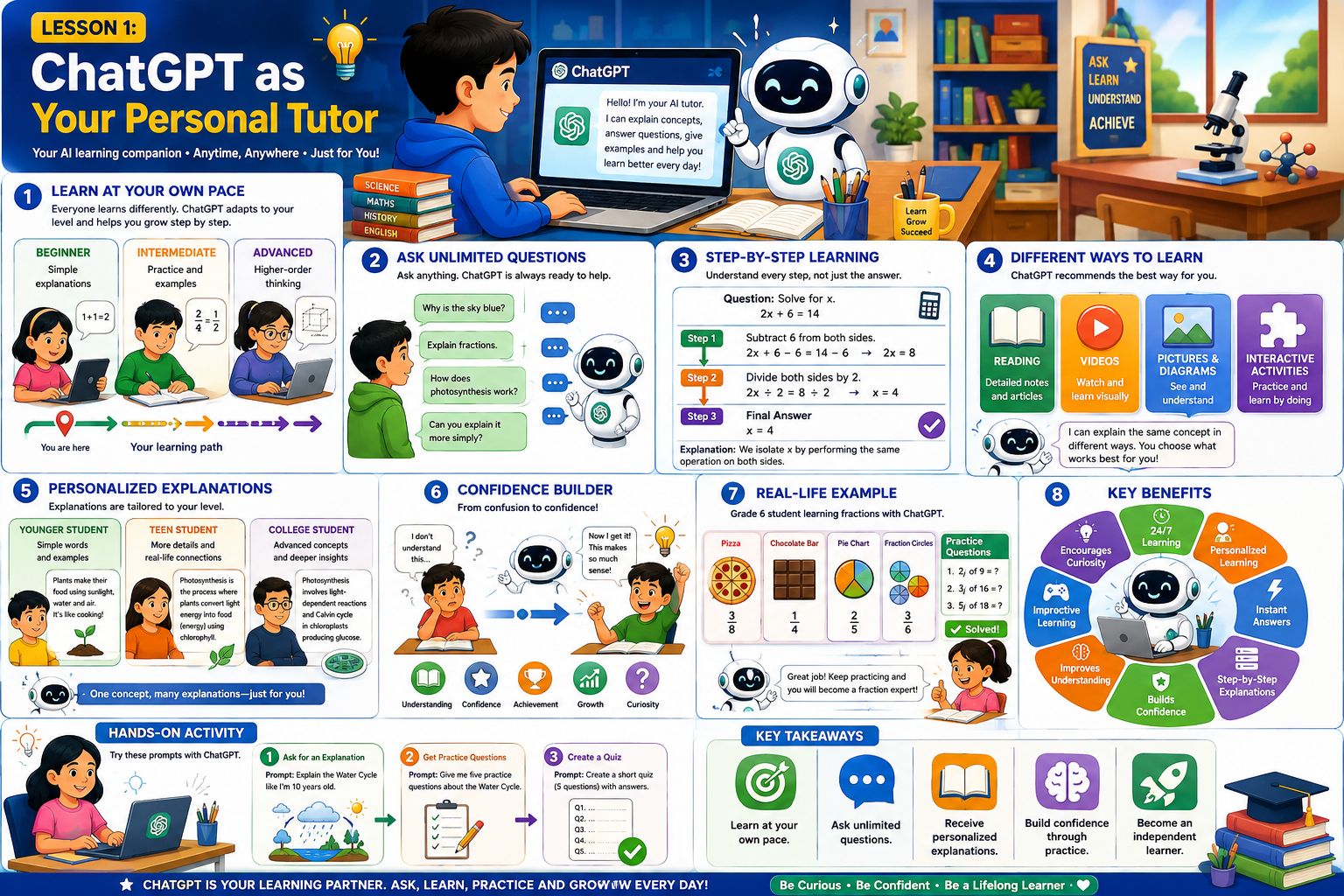
Every student learns differently. Some students understand new ideas quickly, while others need additional explanations, examples, or practice. ChatGPT can act as a personal tutor that is available anytime to explain concepts, answer questions, and guide learning.
Unlike a search engine that provides a list of websites, ChatGPT engages in a conversation. Students can ask follow-up questions, request simpler explanations, or explore a topic in greater depth.
Topics Covered
- What is an AI tutor?
- Benefits of personalized learning
- Learning at your own pace
- Asking follow-up questions
- Receiving step-by-step explanations
- Building confidence
Example
A Grade 6 student does not understand fractions.
Instead of memorizing formulas, the student asks ChatGPT:
Explain fractions using a pizza example.
ChatGPT responds with a simple visual explanation and provides practice questions.
Example Prompt
Act as a Grade 6 mathematics teacher. Explain fractions using simple language, everyday examples, and five practice questions.
Hands-on Activity
Ask ChatGPT to explain one topic you find difficult.
Quiz
- What is the main advantage of using ChatGPT as a tutor?
- Why should students ask follow-up questions?
Key Takeaway
ChatGPT supports personalized learning by adapting explanations to each student’s level of understanding.
2: Homework Assistant
Introduction
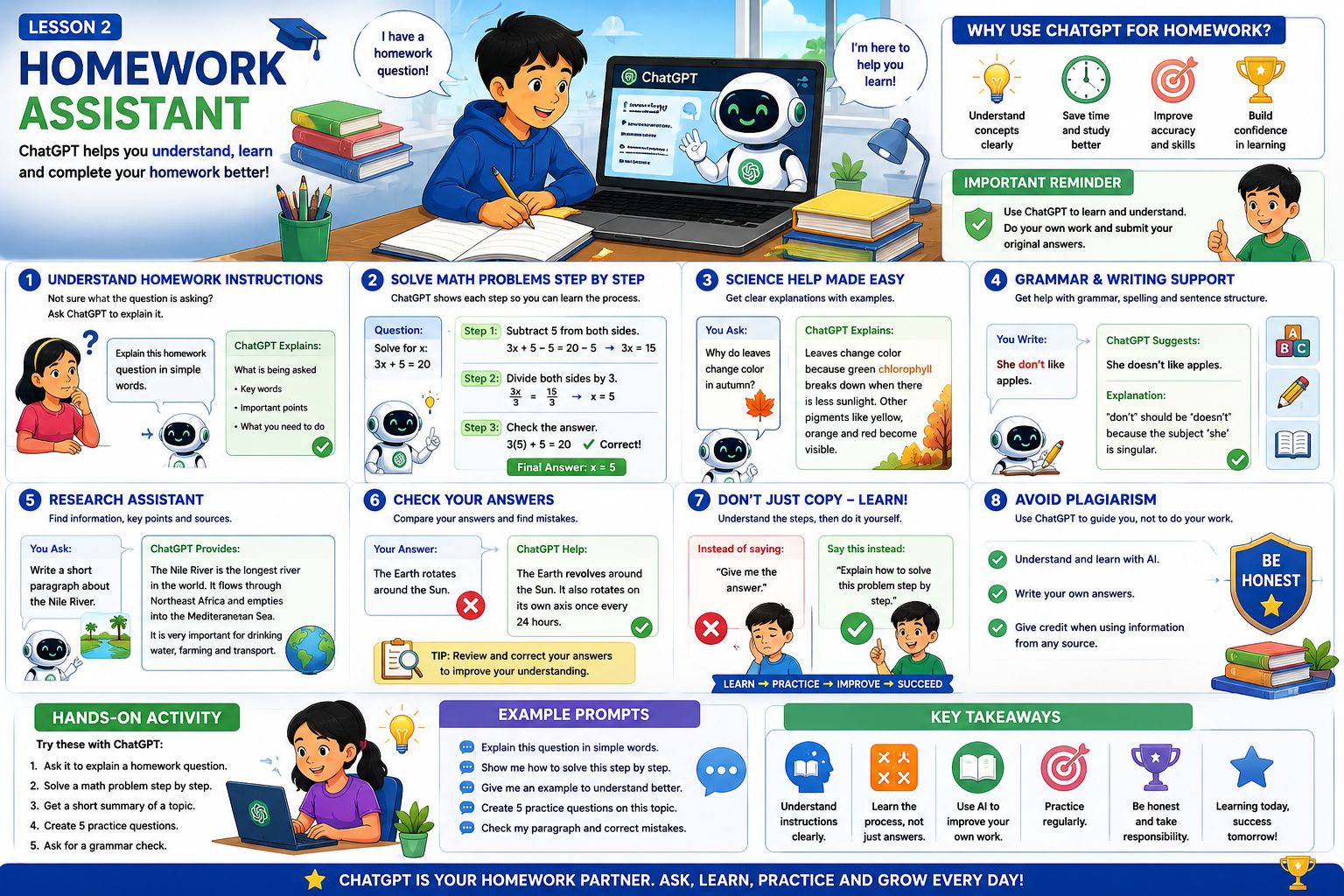
Homework reinforces classroom learning. Sometimes students may struggle to understand instructions or solve difficult questions. ChatGPT can guide students through the learning process without simply providing answers.
Students should use ChatGPT to understand concepts and improve their problem-solving skills rather than copying responses.
Topics Covered
- Understanding homework instructions
- Solving mathematics step by step
- Science explanations
- Grammar support
- Research assistance
- Checking answers
- Avoiding plagiarism
Example
Instead of asking:
Solve this question.
Ask:
Show me how to solve this problem step by step and explain why each step is necessary.
Example Prompt
Explain how to solve this algebra equation step by step without skipping any steps.
Activity
Use ChatGPT to understand a homework question before attempting it independently.
Quiz
- Why is copying AI-generated homework discouraged?
- How can ChatGPT improve homework quality?
Key Takeaway
Use ChatGPT to learn the process, not simply to obtain answers.
3: Study Smarter with ChatGPT
Introduction
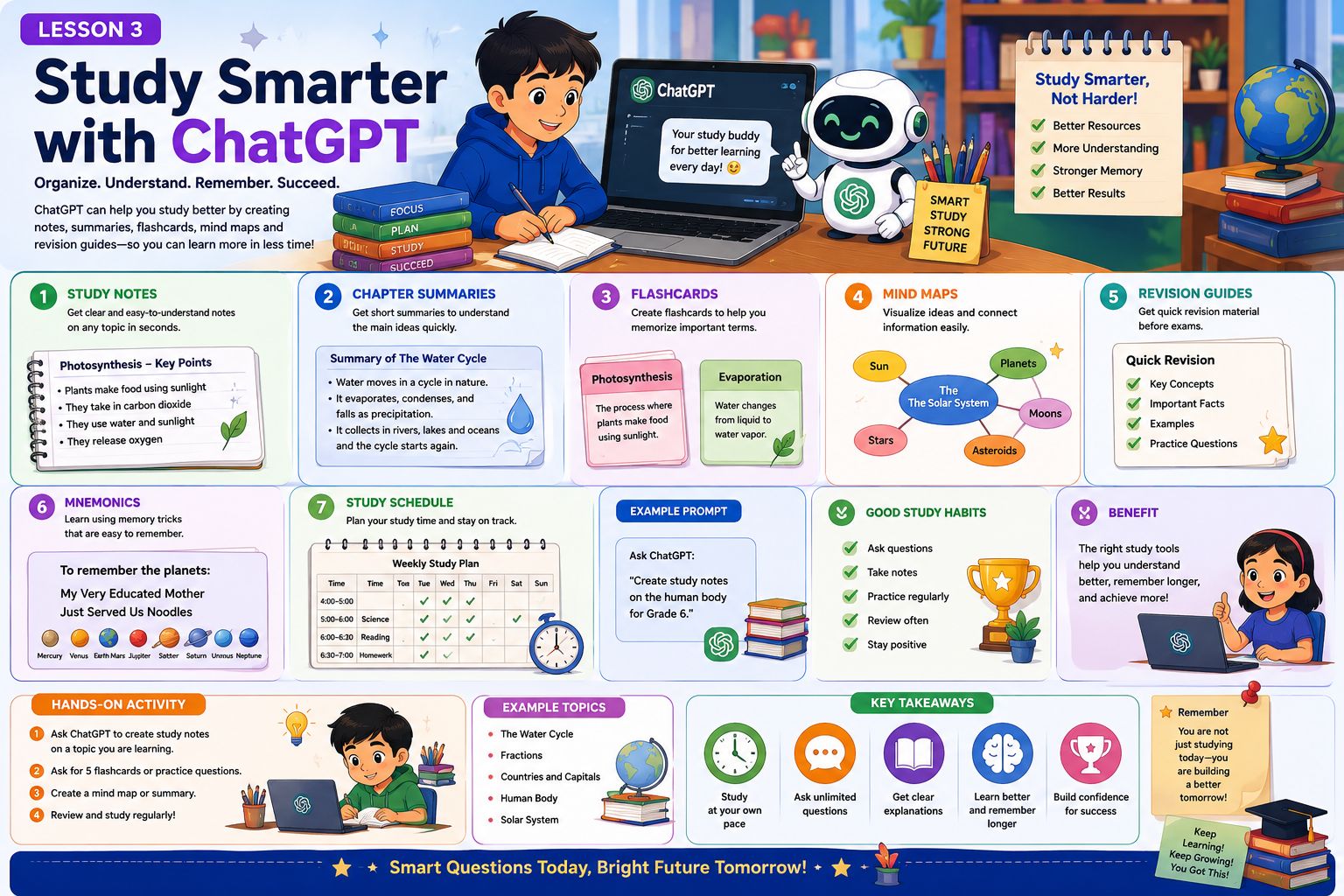
Effective studying involves understanding, reviewing, and remembering information. ChatGPT helps students create organized study materials, making revision easier and more efficient.
Topics Covered
- Study notes
- Chapter summaries
- Flashcards
- Mind maps
- Revision guides
- Mnemonics
- Study schedules
Example
A student preparing for biology asks ChatGPT to summarize a chapter into one page and create flashcards.
Example Prompt
Summarize Chapter 5 into easy-to-understand study notes and create ten flashcards.
Activity
Create a one-week revision plan using ChatGPT.
Quiz
- What are flashcards used for?
- Why are summaries useful?
Key Takeaway
Organized study materials improve understanding and long-term retention.
4: Exam Preparation
Introduction
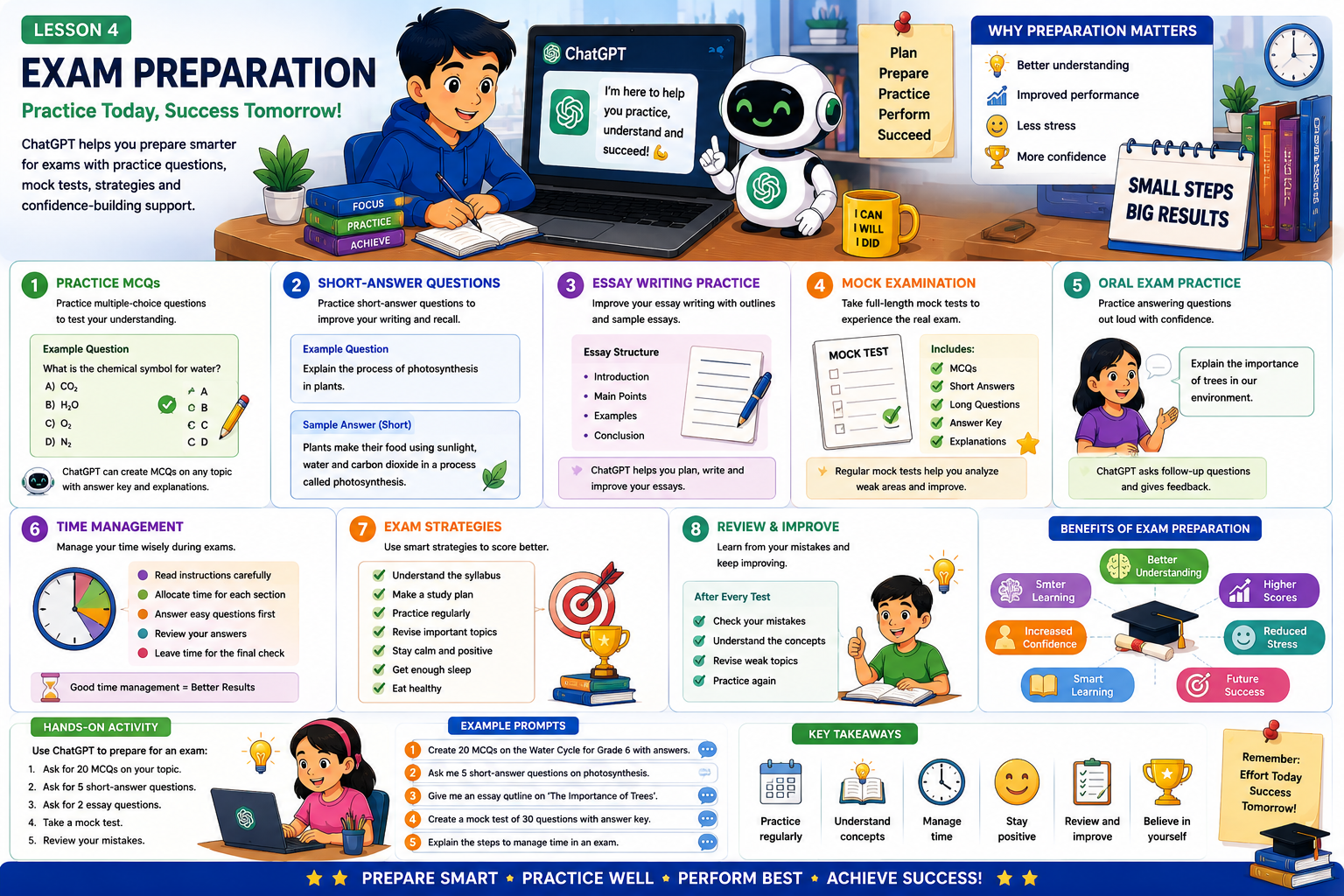
Examinations measure knowledge, understanding, and application. ChatGPT can help students prepare through practice tests, revision questions, and time management strategies.
Topics Covered
- Practice MCQs
- Short-answer questions
- Essay writing practice
- Mock examinations
- Oral examination practice
- Time management
- Revision strategies
Example
A student preparing for a science examination asks ChatGPT to generate a mock test with an answer key.
Example Prompt
Create a Grade 8 science mock examination with twenty multiple-choice questions, five short-answer questions, and detailed explanations.
Activity
Take a practice test and review incorrect answers.
Quiz
- Why are mock examinations helpful?
- What should students do after completing a practice test?
Key Takeaway
Regular practice and self-assessment improve examination performance.
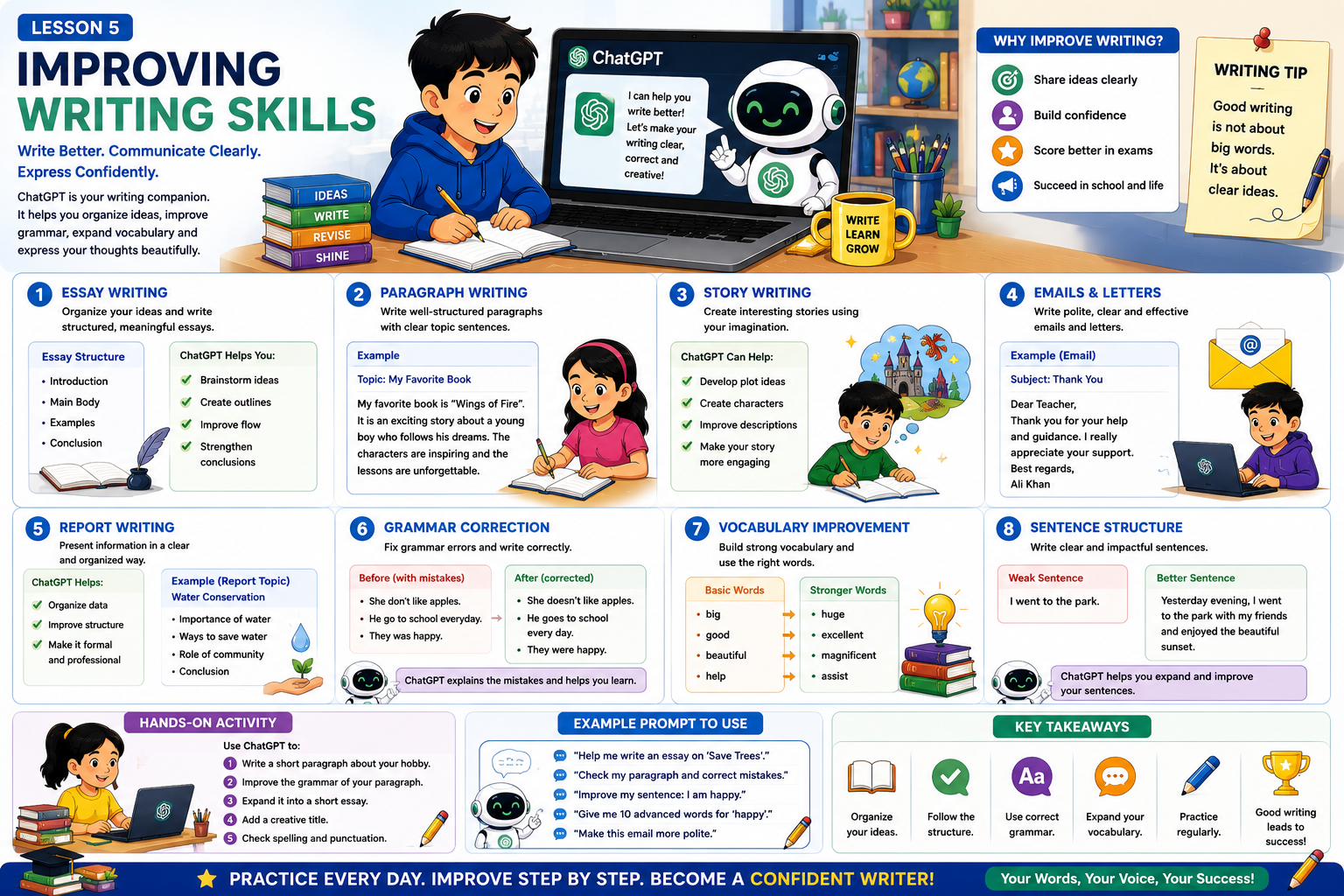
5: Improving Writing Skills
Introduction
Strong writing skills help students communicate ideas clearly and confidently. ChatGPT can support writing by suggesting improvements while encouraging students to develop their own voice.
Topics Covered
- Essays
- Paragraph writing
- Stories
- Emails
- Reports
- Grammar
- Vocabulary
- Sentence structure
Example
A student writes an essay and asks ChatGPT to identify grammar mistakes and suggest improvements without rewriting the entire essay.
Example Prompt
Review my essay and suggest improvements for grammar, organization, and vocabulary while keeping my original ideas.
Activity
Write a short paragraph and use ChatGPT to improve it.
Quiz
- Why should students edit rather than copy AI-generated writing?
- How can ChatGPT improve vocabulary?
Key Takeaway
ChatGPT helps students become stronger writers through feedback and revision.
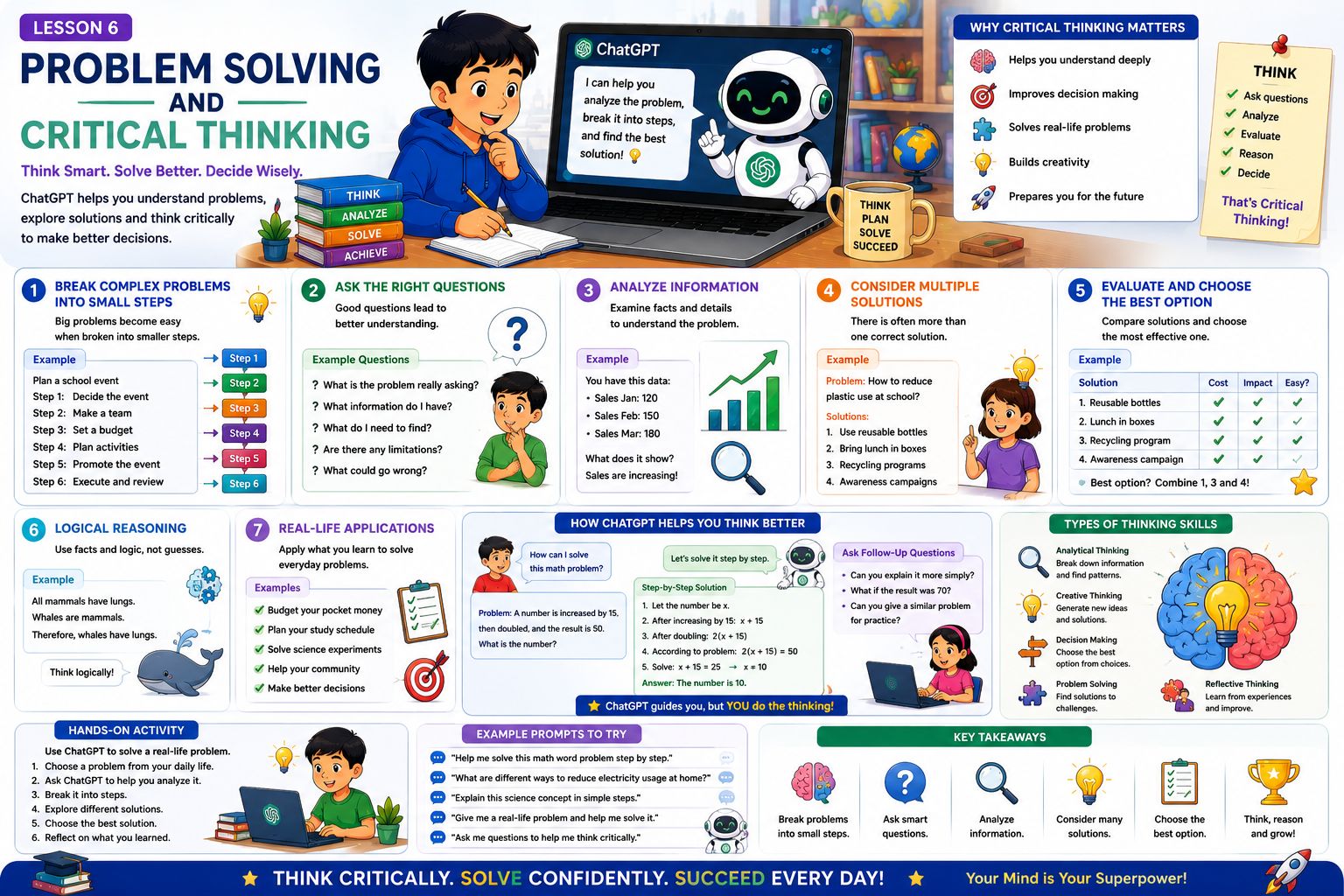
6: Problem Solving and Critical Thinking
Introduction
Problem-solving involves analyzing information, evaluating options, and making logical decisions. ChatGPT can guide students through reasoning rather than simply providing solutions.
Topics Covered
- Breaking problems into steps
- Logical reasoning
- Mathematics
- Coding
- Science investigations
- Decision-making
- Real-life applications
Example
A student asks ChatGPT to explain how to solve a word problem instead of requesting only the final answer.
Example Prompt
Explain your reasoning while solving this mathematics problem and ask me questions after each step.
Activity
Solve one challenging problem using guided assistance.
Quiz
- Why is understanding the process more important than memorizing answers?
- How does logical reasoning improve learning?
Key Takeaway
Critical thinking develops when students understand how and why solutions work.
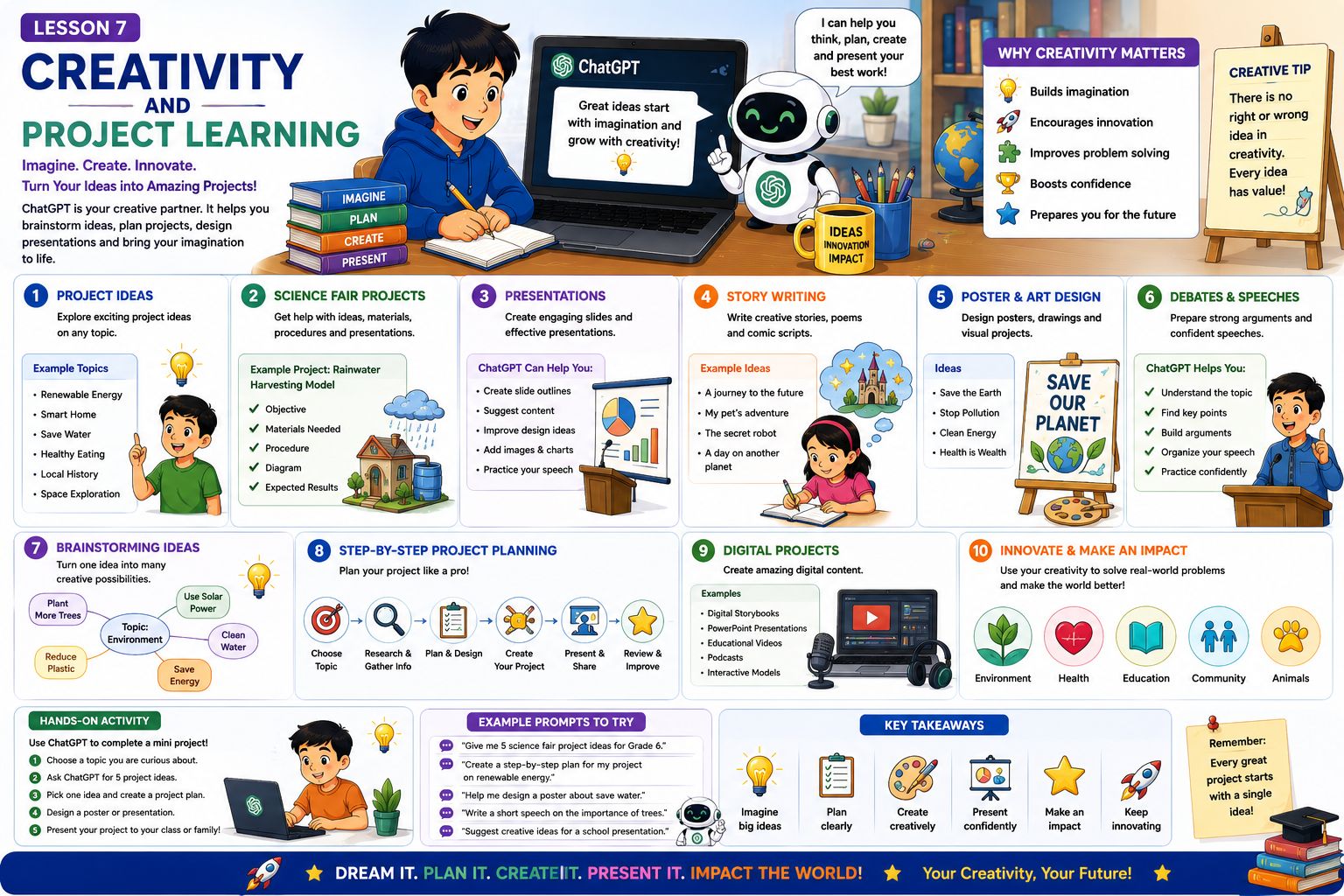
7: Creativity and Project Learning
Introduction
Creativity is an important skill for the future. ChatGPT can support brainstorming, project planning, storytelling, presentations, and innovation while encouraging original thinking.
Topics Covered
- Project ideas
- Science fairs
- Presentations
- Story writing
- Debate preparation
- Posters
- Brainstorming
- Innovation
Example
A student preparing for a science fair asks ChatGPT to suggest environmentally friendly project ideas.
Example Prompt
Suggest five Grade 7 science fair projects related to renewable energy with objectives, materials, and procedures.
Activity
Create a project proposal using ChatGPT.
Quiz
- How does brainstorming improve creativity?
- Why should students personalize AI-generated ideas?
Key Takeaway
ChatGPT helps students transform ideas into creative projects while encouraging originality.
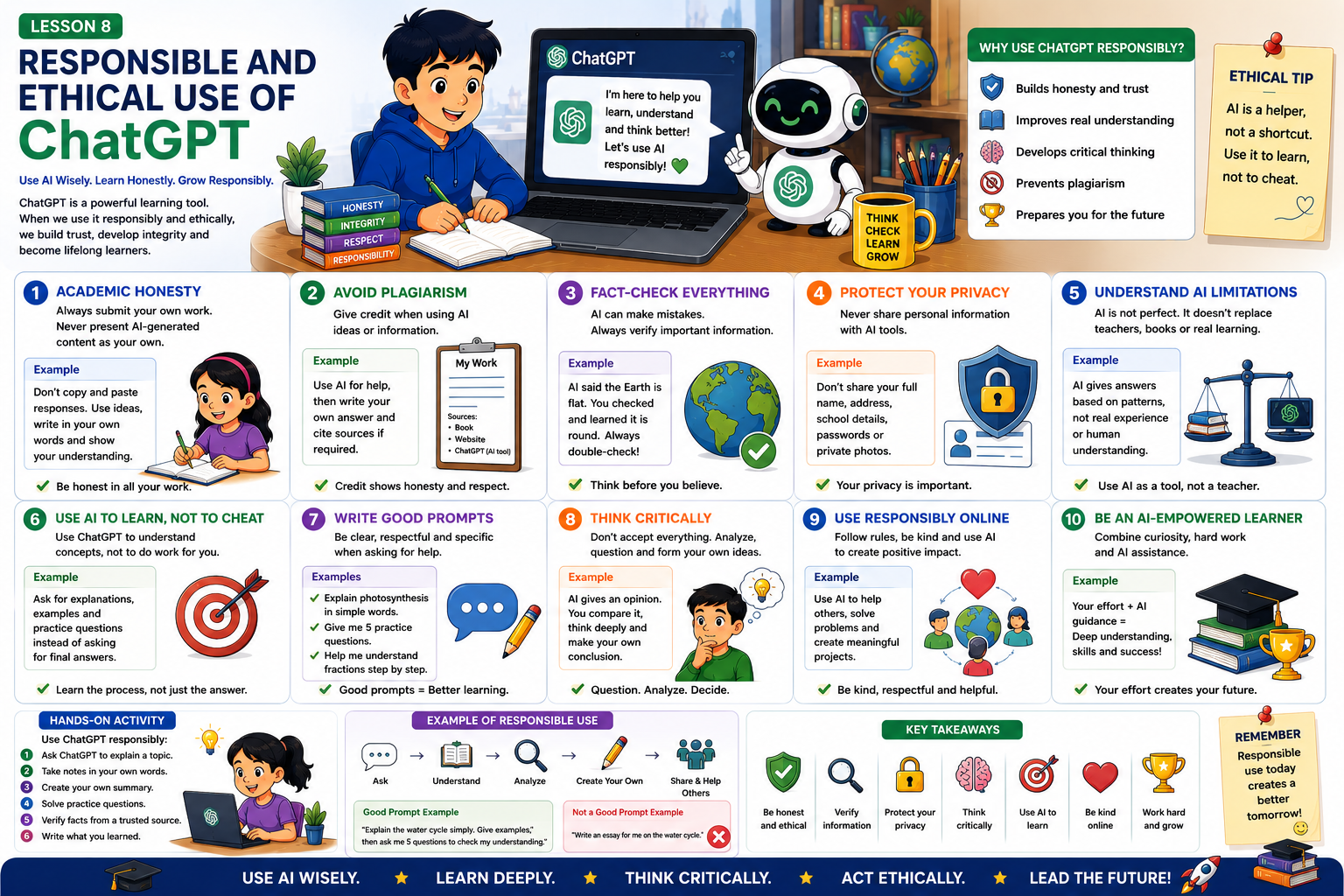
8: Responsible and Ethical Use of ChatGPT
Introduction
AI is a valuable learning tool, but it should be used responsibly. Students should use ChatGPT to improve understanding rather than replacing their own effort.
Responsible AI use builds honesty, critical thinking, and lifelong learning habits.
Topics Covered
- Academic honesty
- Avoiding plagiarism
- Fact-checking AI responses
- Protecting personal information
- Understanding AI limitations
- Responsible prompt writing
- Independent learning
Example
Instead of submitting AI-generated work unchanged, a student uses ChatGPT to understand the topic, writes an original response, and cites sources when required.
Example Prompt
Explain this history topic in simple language and then ask me questions so I can demonstrate my understanding.
Activity
Compare an AI-generated answer with your own answer and identify improvements.
Quiz
- Why is plagiarism unethical?
- Why should AI-generated information be verified?
Key Takeaway
The most successful students use ChatGPT as a learning partner—not as a shortcut. Responsible use encourages independent thinking, academic integrity, and continuous learning.
Module Summary
This module demonstrated how ChatGPT can support students throughout their learning journey—from understanding difficult concepts and completing homework to preparing for examinations, improving writing, solving problems, developing creativity, and using AI ethically. When students combine AI assistance with curiosity, critical thinking, and consistent effort, they become more confident, independent, and successful learners.
Practical Assignment
Choose a topic from one of your school subjects and use ChatGPT to:
- Explain the concept in simple language.
- Create study notes.
- Generate a mind map.
- Develop ten flashcards.
- Create a practice quiz.
- Design a one-page revision guide.
- Write five reflection questions.
- Summarize what you learned in your own words.
Final Module Assessment
The module concludes with:
- 20 Multiple-Choice Questions
- 5 Short-Answer Questions
- 2 Scenario-Based Questions
- 1 Prompt-Writing Exercise
- 1 Practical AI Learning Task
- 1 Self-Reflection Activity
This mirrors the professional structure of Module 4 while focusing entirely on helping students become independent, responsible, and effective AI-assisted learners